Showing posts with label astronomy. Show all posts

Friday, April 4, 2014

A Sea in Space: Scientists Announce Saturn's Moon has a Watery Ocean


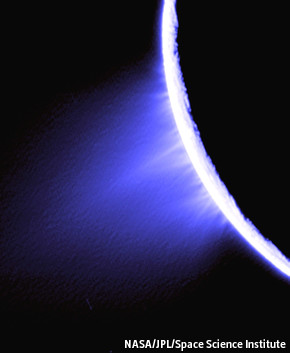
Scientists have confirmed today that Enceladus, one of Saturn's moons, has a watery ocean. The Guardian has an excellent article discussing how "water is not the only factor that makes Enceladus such a promising habitat. The water is in contact with the moon's rocky core, so elements useful for life, such as phosphorus, sulfur and potassium, will leach into the ocean."

Previously, Europa — another of Saturn's moons — was considered the place that was most likely for mankind to find life on. Europa also has a liquid ocean but it also has an oxygen atmosphere. On the other hand on Enceladus we now have contact from the rocky core. So what's the ocean on Europa in contact with, if not a rocky core?

 Europa and Enceladus


Europa has a drastically different structure than Enceladus. If you compare the densities:
  • Europa: 3.01 g/cm³ 
  • Enceladus: 1.61 g/cm³ 
In general, the further from Sun you go, the sparser the material gets. Mercury is the closest to the Sun and has a large metallic core, Mars is already much less dense than Earth, and the trend continues in the outer Solar system. (Jupiter has a similar trend inside its moon system, where Io and Europa are denser than Ganymede and Callisto). This is because more volatile material was pushed to the outside regions of Solar system during formation, leaving denser materials closer to the Sun.

Jupiter probably had a similar effect on its moons, as it probably generated a lot of heat through gravitational contraction and accretion during the early stages of formation. This means that while Europa has a similar structure to Earth's Moon and Mars, with a rocky crust and mantle and a small metallic core (compared to Earth). Enceladus was formed from material with much less heavier materials and much more ices (water, ammonia, methane - which are in general more abundant in space than rocks or metals). This means that it has, in theory, an icy, not rocky crust and mantle, and a rocky core, with only traces of metals.

What this study shows is that at least a part of its icy mantle is molten, similar to how Earth's asthenosphere (upper mantle) is ductile - partially molten.

Monday, September 16, 2013

Hangout with SETI

SETI satellite

SETI Institute researchers Jill Tarter and Franck Marchis (host & moderator) will hangout with Jason Wright, professor of astronomy at Penn State, Matt Povich, professor of astronomy at Cal Poly Pomona and Freeman Dyson, theoretical physicist and mathematician of the Institute for Advance Studies. These scientists will discuss the potential for the WISE telescope to detect extraterrestrial super-civilizations that acquired large a energy supply by building a mega-structure to harvest the energy of their star ("Dyson Sphere") or their entire galaxy. The title of the event is "Searching for Kardashev Type II and III Civilizations with WISE."

This is a public event and will occur Wednesday, September 18th at 11am. This hangout is the first of the SETI Institute's Curiosity Series.

Sunday, July 7, 2013

Astronomy at Lick Observatory

Image courtesy Thirty Meter Telescope

A New Opportunity for Group Observing at the Lick Observatory

The Friends of Lick Observatory is introducing the "Saturday Stars" program at the Observatory's Main Building on Mt. Hamilton. These events are planned for amateur astronomers and others with a keen interest in astronomy.

Groups of 20 - 30 people will have the opportunity to observe a variety of astronomical objects through both the historic 36” Lick Refractor using its eyepiece and the 40” Nickel Reflector equipped with a CCD direct imaging camera; the camera has a 6.3x6.3-arcminute field of view and B, V, R, and I filters. Groups will be able to request the objects they would like to observe and will have access to that night's digital images from the Nickel Telescope. Participants may also bring their own telescopes to this prime viewing site.

Each event will start just prior to sunset, and the Lick Observatory Gift Shop will be open for the first hour of the night. Observing will commence at 11 degree twilight and end after 4 hours.

These exclusive astronomy events are scheduled for the following Saturday nights this summer: July 20, August 3, August 17, August 31, and September 21. The group rate is $1,000 for up to 30 people.

For more information or to sign up for one of these nights, please contact Paula Towle at ptowle@ucolick.org or (831) 459-2991. For questions regarding payment, please contact Leah Martin at lmartin@ucolick.org or (831) 459-5164. For technical questions regarding telescope limits and the CCD camera, please contact Elinor Gates at egates@ucolick.org or (831) 459-5910.

Monday, April 1, 2013

Wise Up! April Fools' from the Science Community

Pranking people is a grand tradition that dates back to who-knows-when, and science pranks for April 1st are no exception. Since the average reader is perhaps quite liable to believe what they read, scientists are at an advantage on this day. After all, who expects a boring scientist to have a sense of humor?

Below are some of the best April Fools' pranks perpetuated by the science community:
Google's Copernicus Center
1959: Dr. Arthur Hayall—not a real person—from University of the Sierras—not a real place—claimed that the moons of Mars were actually artificial satellites. The rumor ran that the Martians were using the satellites as bases. 

1974: John Gribbin published The Jupiter Effect, which stated that the Grand Alignment of planets meant that Armageddon would arrive on March 10th, 1982. (Spoiler: It didn’t.) 

1976: BBC Radio 2 astronomer Patrick Moore announced that at 9:47 a.m. that day, Pluto would pass directly behind Jupiter and their combined gravitational forces would combine to lessen Earth’s gravity. He helpfully hinted that listeners jump into the air at that time to experience less gravity and increasing their buoyancy. 

1996: Discover Magazine announced the discovery of a “bigon,” a new fundamental particle of matter that appears and disappears in mere millionths of a second, and also happened to be the size of a bowling ball. Everything from sinking soufflés to spontaneous human combustion was blamed on the bigon. 

1998: Nature reported a “near-complete skeleton of a theropod [T. rex-like] dinosaur in North Dakota”— which was implicitly suggested to have breathed fire—discovered by Randy Sepulchrave of the Museum of the University of Southern North Dakota. Of course there is no University of Southern North Dakota and the skeleton, dubbed Smaugia volans, derived its name from Tolkien’s The Hobbit. Furthermore, Sepulchrave is a famous fictional character who believed he was an owl and died in a dramatic attempt to fly from a high tower. 

1999:  The Red Herring Magazine published an article on how users could, through a technology developed by computer genius Yuri Maldini, send emails telepathically of up to 240 characters. The magazine received numerous letters from intrigued readers. 

2004: Google announced that they were opening their Copernicus Center, which would be a “lunar hosting a research” site. Applicants need not apply if they couldn’t live without “modern conveniences as soy low-fat lattes, The Sopranos and a steady supply of oxygen.” 

2005: The day before April Fools’, NASA’s Astronomy Picture of the Day contained a teaser announcement “Water on Mars!” The photo ended up depicting a glass of water sitting on a Mars bar, and now the idea that there might actually be water on the red planet doesn’t seem so silly after all. 

2008: The BBC claimed to have discovered a colony of flying penguins and released footage, narrated by Monty Python’s Terry Jones in a David Attenborough-esque manner. (Watch the video here.) 

2012: A mock study titled “On the influence of the Illuminati in astronomical adaptive optics” (pdf warning) described how the nefarious shadow cult is to blame for pretty much everything, including Brittney Spears’ and Lady Gaga’s “astronomical rise to the top.”

Wednesday, March 27, 2013

Celestial Sightings

Just about every evening before going to bed, I take a moment to look at the stars. While the weather isn’t always agreeable, when it’s clear there’s always something worth seeing.  Last Sunday, for example, there was the beautiful sight of Jupiter and the neighboring crescent moon closely paired together.

Tomorrow night, be on the lookout for the waning moon (after all, yesterday was the worm moon — the first full moon in March) sandwiched between Spica and Saturn. You will be able to find the moon midway between the star and the planet, which are currently 17° apart.

Spica will be the white star to the moon’s upper right and Saturn will be more creamy-colored down to the moon’s lower left. Because such a full moon would usually wash out anything in its near vicinity, this degree of separation will actually help the casual observer spot the trio. It will be easiest to spot this celestial arrangement in the southeast after 11 p.m.


Spica is the brightest star in the constellation Virgo

Light from the moon, reflected from the sun, takes only 1.25 seconds to reach the earth. The light from Saturn, 830 million miles away, takes about 74 minutes. However, the light from Spica, a 1st magnitude blue giant, takes about 260 years to finally reach our eyes. So be aware that the light you'll see left the brilliant star well before the American Revolution.

For more on lunar occulations and the best time to see this trio in your area check out details here.

Friday, March 15, 2013

Reddit AMA: Alex Filipenko


Yesterday, Alex Filipenko, a famous astronomer as well as an astrophysics professor at UC Berkeley, did an AMA on Reddit. For those who don't know, an AMA is an "Ask Me Anything" done Q&A style on the social media site. Most of the questions revolved around the future of space exploration and research. Below I have posted some of the more insightful questions with the corresponding responses. You can view the AMA yourself, here.

Q: Where do you think we will be regarding space travel/research in 50 years? 100 years?
A: Hard to say, that far in advance. I hope we will understand dark matter and dark energy. I hope definitive evidence for extraterrestrial life is found by that time. I'm almost certain we will have directly detected gravitational waves. Regarding space travel, maybe within that time, people will land on Mars for the first time.

Q:  How will we understand or detect dark matter/energy? Will this happen in the next 50 years?
A: Physicists are trying to directly detect dark matter in terrestrial labs. I think dark matter will be found this way in the next 20 years and if not, we need to go back to the drawing board! Dark energy will be much more difficult to directly detect, so I'm not sure it will happen in the next 50 years. Without direct detections, a more complete understanding of both dark matter and dark energy will come from from detailed observations of how they affect the universe. Other astrophysicists and I are busy collecting data that are setting ever more precise constraints on the physical nature of dark matter and dark energy.

Q: You mentioned education reform; what kind of reform do you think would help instill an actual love of knowledge in kids today? Do you think that our current system of just memorizing things and taking tests is sufficient? What do you think we can do instigate that change?
A:  Education reform is a very difficult issue. We have to excite kids about math and science at an early age. We might succeed in part by making these subjects more fun (check out http://www.piZone.org, for example). We have to show kids how math and science are relevant to their lives, and how beautiful they are. Of course, some facts must be taught, but the process of science and discovery should be emphasized more.

Q: What do you think of all the exoplanets being discovered?
A: It's totally fantastic! This is truly a "golden age" for research on exoplanets. In the past few years, the Kepler spacecraft has found a few thousand exoplanet candidates, more than 90% of which are probably genuine exoplanets. Studies of the "Doppler wobble" of the stars they orbit, and other observations, are gradually confirming more than more of them. Some are in, or near, the "Goldilocks zone" where liquid water might be found on the surface. Some are roughly the size of Earth. These will be excellent locations to search for life.

Q: What made you decide on astrophysics as a career?
A:  I've always been fascinated by science. From ages 10 through 17, my main interest was chemistry, but as a freshman in high school I was given a small telescope. With it, I "discovered" Saturn the third "star" at which I pointed the telescope! This really jazzed me, and astronomy became a growing interest. In my freshman year of college, at the University of California at Santa Barbara, I took an introductory astronomy course from Professor Stanton J. Peale, and it was truly wonderful. I realized that the physics of the very large is governed by the physics of the very small (atoms and subatomic particles), so by switching to astrophysics I could "have it all." So I changed majors with the intention of becoming an astrophysicist, and I've never regretted the choice.
One final factor in my decision: As a budding young chemist, I played with explosives and had a couple of pretty bad accidents. I realized that I don't have the self-discipline to stay away from dangerous chemicals, so I should switch fields as an act of self-preservation, if nothing else!

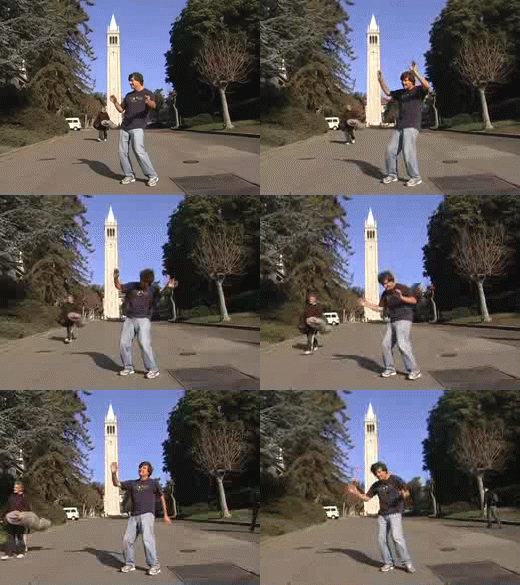
Go here to read the rest of his responses, some more serious and some more silly. (Fun aside: Someone also posted a GIF of Filipenko dancing on the Berkeley campus.)
Friday, December 14, 2012

Geminid Meteor Shower

If it's clear where you live, take a look at the Geminid meteor shower tonight, starting around 10 pm but especially after midnight. The peak was last night (Dec. 13/14), but tonight (Dec. 14/15) should be quite good as well. You can look anywhere in the sky. For more information, check out the EarthSky site.

Monday, November 5, 2012

Hunting for the Higgs Boson

If you're in the East Bay tonight, you should check out the 2012 Segre Lecture at UC Berkeley. Peter Jenni, a CERN Scientist and former ATLAS Spokesperson, will present "Hunting for the Higgs Boson and more at the LHC." 

This annual lecture was conceived as a way for the Physics Department to honor and bring the work of an experimental physicist to the general public. Many renowned experimental physicists have been hosted. The observation of the Higgs Boson at the LHC was easily the biggest science story of the year, so this should be an excellent lecture. It will begin at 5PM in the Pauley Ballroom and is an lecture that any budding astronomer or science enthusiast won't want to miss! Click here to say you're going.

The lecture abstract is as follows:

For the past three years, experiments at the Large Hadron Collider (LHC) have begun exploring physics at the high energy frontier. A rich harvest of initial physics results has been obtained that allows us to test the Standard Model (SM) of elementary particles and to make searches Beyond the SM (BSM), at the highest energy level ever reached in a laboratory. Most exciting is the recent discovery of a new particle that may well be the long-awaited Higgs Boson. This discovery would also establish the postulated electro-weak symmetry breaking mechanism in the SM. Other far-reaching results can be reported for BSM physics searches like Supersymmetry (SUSY) and its implication for Dark Matter in the Universe, Extra Dimensions, and the production of new heavy particles. Besides these physics results, the history and technical challenges of the LHC project, its status, future physics prospects, as well as Cal and LBNL’s prominent role in them will also be covered briefly in this talk.

Wednesday, October 24, 2012

Bay Area Science Festival


The Bay Area Science Festival is a week-long celebration of science that kicks off later this week. UC Berkeley and Science@Cal are involved in a number of exciting events, beginning with not one, but two star parties on Friday (one at the Lawrence Hall of Science for everyone, and a second teen-exclusive event at the YMCA Teen Center in downtown Berkeley).

You can also hike the Hayward Fault with UC Berkeley seismologists, explore what you eat at local farmers' markets, learn about the amazing things plants can do, enjoy the chemistry of brunch, investigate the intersection of art and science at a two-night exclusive gallery gala in downtown Berkeley, and join 25,000 others for the big finale at AT&T Park on November 3rd.

Many of these events are free. For a few of them, a small fee applies and / or registration is required.
Details of Science@Cal's participation in these events can be found on their website here.

The main festival webpage, featuring other events taking place across the Bay Area, is at Bay Area Science.

Also, save the date for the next Science@Cal lecture, November 17th, featuring Prof. Rosemary Gillespie, Director of the Essig Museum of Entomology, talking about evolution on remote islands.

Science Education Kickstarter


Wonderfest, the nonprofit San Francisco Bay Area Beacon of Science, has just begun a Kickstarter campaign to support a new, online, video series called "Radical Physics." Alex Filippenko, one of the world's most highly cited astronomers and a professor at UC Berkeley, will be part of the series.

You can take part by contributing as little as $1. And if you want a tangible reward, you can pledge $10 or more. All contributions (including big ones!) will be very welcome, and are tax deductible.

To appreciate this campaign -- and the educational need for Radical Physics -- please see the following web page. If you wish, watch the short-and-fun video and check out the various rewards of the Energy Radical Physics Video Series.

Friday, August 31, 2012

Lick Observatory Event

On Saturday, September 15, at Lick Observatory--located at Mt. Hamilton, about an hour drive from San Jose--there will be a "BBQ with the Stars." In addition to the barbeque dinner, there will be live music, entertaining and informative astronomy lectures, and viewing through the observatory's large historic telescopes. Professor Alex Filippenko will be one of the main speakers, along with Sandra Faber (Interim Director, University of California Observatories), Professor Geoff Marcy (the world's leading hunter for planets orbiting other stars, and Timothy Ferris (one of the world's best science writers).

Dinner catered by Bruno's Barbeque (with vegetarian options) will be served from 5 to 7 p.m., followed by astronomy talks and viewing through the large telescopes from 7:30 to 10:30 p.m. The talks will be at a level suitable for the lay public, including kids. There will be plenty of time to ask questions of the astronomers, too. Musical entertainment will be provided by Silicon Valley's Dr. West playing live 1970s music, and classical guitar duo Equilibrium.

Tickets to this very special event are limited and must be purchased in advance by calling the UC Santa Cruz Ticket Office at (831) 459-2159 or online at www.SantaCruzTickets.com . Admission is only $60 per person (plus a small ticket service fee), and proceeds benefit Lick Observatory's extensive public programs. Hope to see you there!

Friday, August 10, 2012

Annual Perseid Meteor Shower

The annual Perseid meteor shower is coming on Saturday night, and I encourage you to view it. (Friday and Sunday nights should be okay, too, but not quite as good.) The shower peaks around 2-4am PDT on Sunday, August 12 (that is, Saturday night, August 11). Try to get as far away from city lights as possible. No binoculars or telescopes are needed; just view the sky with your unaided eyes from as dark a location as possible, away from city lights. Dress warmly, and bring a hot beverage if you wish. You can lie down on a blanket or a lawn chair, for comfort. Looking anywhere in the sky is fine, but views to the northeast should provide the most meteors.

There are many good references with viewing tips, etc. From Astronomy.com:

"If you ask most skygazers to name their favorite meteor shower, the odds are good that `Perseid' will be the first word out of their mouths. This annual shower seemingly has it all: It offers a consistently high rate of meteors year after year; it produces a higher percentage of bright ones than most other showers; it occurs in August when many people take summer vacation; and it happens at a time when nice weather and reasonable nighttime temperatures are common north of the equator. No other major shower can boast all four of these attributes.

 And this year’s Perseid meteor shower promises two other significant advantages. First, it occurs when the Moon is at a waning crescent phase, which means bright moonlight won’t diminish the number of visible meteors. And second, the shower peaks on a Saturday night, August 11/12, so most people can afford to sleep in or at least relax the following day... The crescent Moon, which rises shortly after 1 a.m., won’t have much impact because the shower consistently produces lots of bright meteors. Observers under clear dark skies likely will see 60 to 80 meteors per hour -— an average of at least one per minute —- in the hour or two before twilight starts to break shortly after 4 a.m. local daylight time. By then, the brilliant planets Venus and Jupiter will add to one of the finest predawn shows of 2012."

 Have fun, and I hope you have clear skies!

Friday, July 27, 2012

Astronomy Picture of the Day

Two accomplished astronomers run Astronomy Picture of the Day and put up interesting and gorgeous astronomy pics every day. They have been at it since 1995, and haven't skipped a single day. The look of the website hasn't changed much -- basic HTML, but the one paragraph of text below the picture often gives an insight into our universe and modern astronomy. Their forums are pretty cool too, for those interested.