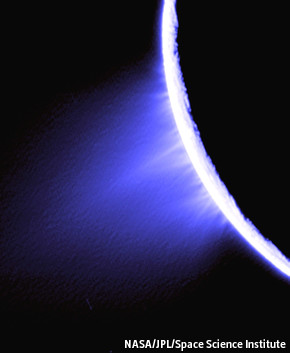
Scientists have confirmed today that Enceladus, one of Saturn's moons, has a watery ocean. The Guardian has an excellent article discussing how "water is not the only factor that makes Enceladus such a promising habitat. The water is in contact with the moon's rocky core, so elements useful for life, such as phosphorus, sulfur and potassium, will leach into the ocean."
Previously, Europa — another of Saturn's moons — was considered the place that was most likely for mankind to find life on. Europa also has a liquid ocean but it also has an oxygen atmosphere. On the other hand on Enceladus we now have contact from the rocky core. So what's the ocean on Europa in contact with, if not a rocky core?
Europa and Enceladus
Europa has a drastically different structure than Enceladus. If you compare the densities:
- Europa: 3.01 g/cm³
- Enceladus: 1.61 g/cm³
Jupiter probably had a similar effect on its moons, as it probably generated a lot of heat through gravitational contraction and accretion during the early stages of formation. This means that while Europa has a similar structure to Earth's Moon and Mars, with a rocky crust and mantle and a small metallic core (compared to Earth). Enceladus was formed from material with much less heavier materials and much more ices (water, ammonia, methane - which are in general more abundant in space than rocks or metals). This means that it has, in theory, an icy, not rocky crust and mantle, and a rocky core, with only traces of metals.
What this study shows is that at least a part of its icy mantle is molten, similar to how Earth's asthenosphere (upper mantle) is ductile - partially molten.


