Showing posts with label moon. Show all posts

Monday, April 1, 2013

Wise Up! April Fools' from the Science Community

Pranking people is a grand tradition that dates back to who-knows-when, and science pranks for April 1st are no exception. Since the average reader is perhaps quite liable to believe what they read, scientists are at an advantage on this day. After all, who expects a boring scientist to have a sense of humor?

Below are some of the best April Fools' pranks perpetuated by the science community:
Google's Copernicus Center
1959: Dr. Arthur Hayall—not a real person—from University of the Sierras—not a real place—claimed that the moons of Mars were actually artificial satellites. The rumor ran that the Martians were using the satellites as bases. 

1974: John Gribbin published The Jupiter Effect, which stated that the Grand Alignment of planets meant that Armageddon would arrive on March 10th, 1982. (Spoiler: It didn’t.) 

1976: BBC Radio 2 astronomer Patrick Moore announced that at 9:47 a.m. that day, Pluto would pass directly behind Jupiter and their combined gravitational forces would combine to lessen Earth’s gravity. He helpfully hinted that listeners jump into the air at that time to experience less gravity and increasing their buoyancy. 

1996: Discover Magazine announced the discovery of a “bigon,” a new fundamental particle of matter that appears and disappears in mere millionths of a second, and also happened to be the size of a bowling ball. Everything from sinking soufflés to spontaneous human combustion was blamed on the bigon. 

1998: Nature reported a “near-complete skeleton of a theropod [T. rex-like] dinosaur in North Dakota”— which was implicitly suggested to have breathed fire—discovered by Randy Sepulchrave of the Museum of the University of Southern North Dakota. Of course there is no University of Southern North Dakota and the skeleton, dubbed Smaugia volans, derived its name from Tolkien’s The Hobbit. Furthermore, Sepulchrave is a famous fictional character who believed he was an owl and died in a dramatic attempt to fly from a high tower. 

1999:  The Red Herring Magazine published an article on how users could, through a technology developed by computer genius Yuri Maldini, send emails telepathically of up to 240 characters. The magazine received numerous letters from intrigued readers. 

2004: Google announced that they were opening their Copernicus Center, which would be a “lunar hosting a research” site. Applicants need not apply if they couldn’t live without “modern conveniences as soy low-fat lattes, The Sopranos and a steady supply of oxygen.” 

2005: The day before April Fools’, NASA’s Astronomy Picture of the Day contained a teaser announcement “Water on Mars!” The photo ended up depicting a glass of water sitting on a Mars bar, and now the idea that there might actually be water on the red planet doesn’t seem so silly after all. 

2008: The BBC claimed to have discovered a colony of flying penguins and released footage, narrated by Monty Python’s Terry Jones in a David Attenborough-esque manner. (Watch the video here.) 

2012: A mock study titled “On the influence of the Illuminati in astronomical adaptive optics” (pdf warning) described how the nefarious shadow cult is to blame for pretty much everything, including Brittney Spears’ and Lady Gaga’s “astronomical rise to the top.”

Wednesday, March 27, 2013

Celestial Sightings

Just about every evening before going to bed, I take a moment to look at the stars. While the weather isn’t always agreeable, when it’s clear there’s always something worth seeing.  Last Sunday, for example, there was the beautiful sight of Jupiter and the neighboring crescent moon closely paired together.

Tomorrow night, be on the lookout for the waning moon (after all, yesterday was the worm moon — the first full moon in March) sandwiched between Spica and Saturn. You will be able to find the moon midway between the star and the planet, which are currently 17° apart.

Spica will be the white star to the moon’s upper right and Saturn will be more creamy-colored down to the moon’s lower left. Because such a full moon would usually wash out anything in its near vicinity, this degree of separation will actually help the casual observer spot the trio. It will be easiest to spot this celestial arrangement in the southeast after 11 p.m.


Spica is the brightest star in the constellation Virgo

Light from the moon, reflected from the sun, takes only 1.25 seconds to reach the earth. The light from Saturn, 830 million miles away, takes about 74 minutes. However, the light from Spica, a 1st magnitude blue giant, takes about 260 years to finally reach our eyes. So be aware that the light you'll see left the brilliant star well before the American Revolution.

For more on lunar occulations — and the best time to see this trio in your area — check out details here.

Saturday, August 11, 2012

Moon Disaster

This is the first page of a speech written by Bill Safire for President Nixon to read if the moon landing went poorly and the astronauts were unable to return. As we know, thankfully it was unnecessary but it's still a poignant insight into the fears and uncertainty of space exploration.


"Unbeknownst to the American people, one of the President's speechwriters, William Safire, was asked to write a statement that the President would make to the American people in the event of a disaster. Though never delivered, it remains an eloquent tribute to the bravery and pioneering spirit of the astronauts. When the astronauts of Apollo XI returned safely to earth, their mission was hailed around the world as an achievement of epic proportions, and this statement was quietly tucked away into the record."


Friday, August 10, 2012

Annual Perseid Meteor Shower

The annual Perseid meteor shower is coming on Saturday night, and I encourage you to view it. (Friday and Sunday nights should be okay, too, but not quite as good.) The shower peaks around 2-4am PDT on Sunday, August 12 (that is, Saturday night, August 11). Try to get as far away from city lights as possible. No binoculars or telescopes are needed; just view the sky with your unaided eyes from as dark a location as possible, away from city lights. Dress warmly, and bring a hot beverage if you wish. You can lie down on a blanket or a lawn chair, for comfort. Looking anywhere in the sky is fine, but views to the northeast should provide the most meteors.

There are many good references with viewing tips, etc. From Astronomy.com:

"If you ask most skygazers to name their favorite meteor shower, the odds are good that `Perseid' will be the first word out of their mouths. This annual shower seemingly has it all: It offers a consistently high rate of meteors year after year; it produces a higher percentage of bright ones than most other showers; it occurs in August when many people take summer vacation; and it happens at a time when nice weather and reasonable nighttime temperatures are common north of the equator. No other major shower can boast all four of these attributes.

 And this year’s Perseid meteor shower promises two other significant advantages. First, it occurs when the Moon is at a waning crescent phase, which means bright moonlight won’t diminish the number of visible meteors. And second, the shower peaks on a Saturday night, August 11/12, so most people can afford to sleep in or at least relax the following day... The crescent Moon, which rises shortly after 1 a.m., won’t have much impact because the shower consistently produces lots of bright meteors. Observers under clear dark skies likely will see 60 to 80 meteors per hour -— an average of at least one per minute —- in the hour or two before twilight starts to break shortly after 4 a.m. local daylight time. By then, the brilliant planets Venus and Jupiter will add to one of the finest predawn shows of 2012."

 Have fun, and I hope you have clear skies!

Saturday, June 2, 2012

Upcoming Partial Lunar Eclipse

On the morning of Monday, June 4, there will be a partial eclipse of the full moon in the few hours before sunrise. About a third of the Moon will enter the Earth’s dark shadow, starting at 3:00 am PDT and ending at 5:06 am PDT (mid-­‐eclipse at 4:03 am PDT). No optical aid is needed to view the eclipse, though binoculars or telescopes will provide a magnified view. There is no danger when viewing a lunar eclipse with the naked eye, binoculars, or telescopes; filters are not needed (unlike the case for a partial solar eclipse). Just go outside wherever you are, and take a look! But some local astronomy clubs and science centers (such as the Chabot Space and Science Center in the Oakland hills) will hold official public viewing sessions; check online.

The entire easily visible part of the eclipse (when the Moon is in the Earth’s “umbra,” or full shadow) will be visible from California. As seen from the central USA, moonset will occur during the eclipse. The eastern US will basically miss out on this eclipse, since it will begin around or after moonset. West of California (say, in Hawaii), the entire eclipse [penumbra (partial, bright shadow) and umbra (full, dark shadow)] will be visible with the Moon high in the sky. For more information, see http://eclipse.gsfc.nasa.gov/OH/OH2012.html#LE2012Jun04P (courtesy of Fred Espenak, NASA’s GSFC.

Monday, May 21, 2012

Photos: Yesterday's Eclipse

DiscoveryNews: Eclipse Over Idaho

Gardnerville, Nevada.  (Photo: Cathleen Allison / AP via The Guardian)

DiscoveryNews: Eclipse in Gilbert, AZ as seen through a Fox 10 News camera.


Friday, May 18, 2012

Rare Annular Eclipse

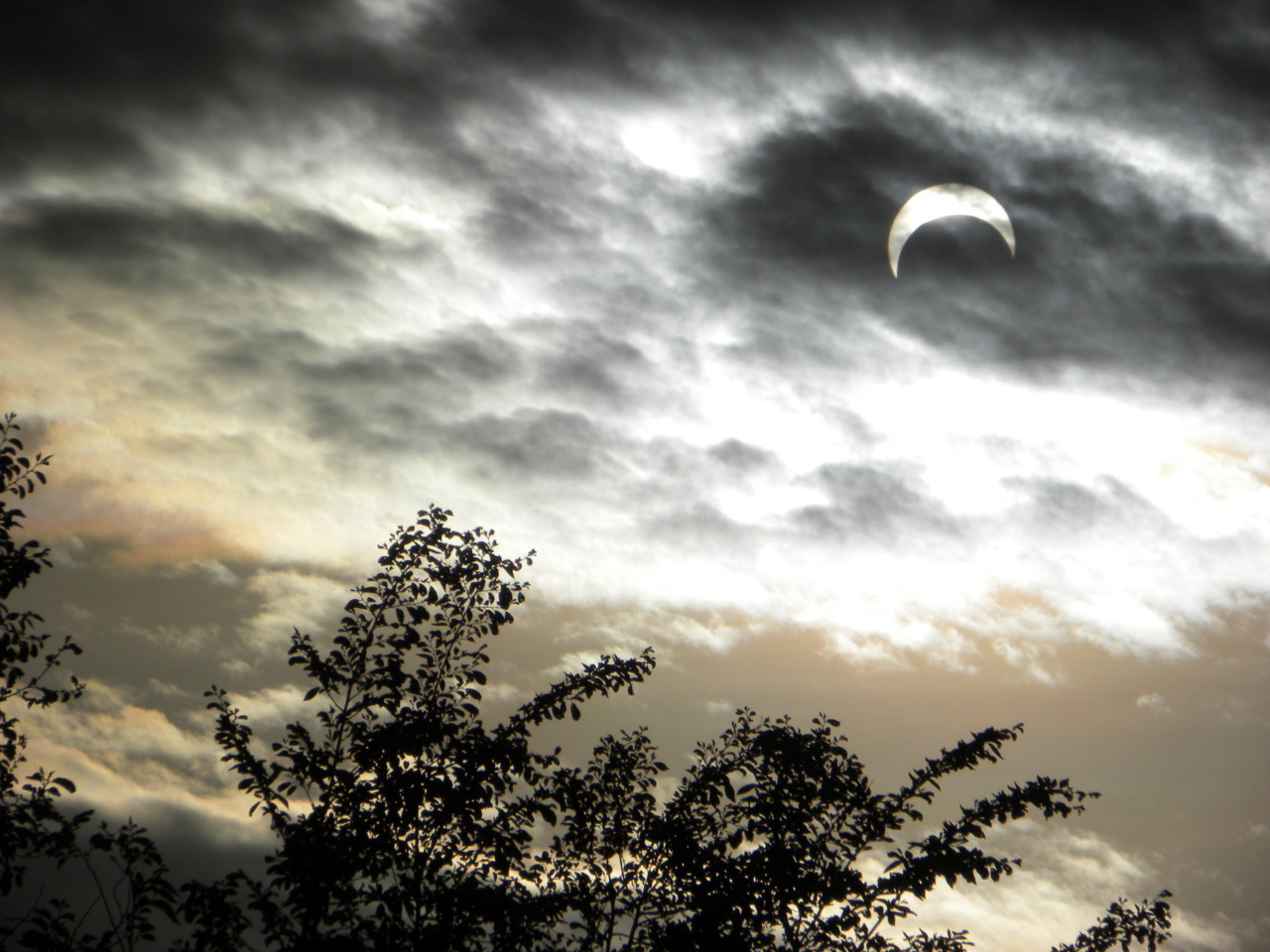
A rare "annular eclipse" of the Sun will occur in our area (northern California) in the late afternoon of May 20, 2012. I encourage you to see it, regardless of whether you can be within the narrow path where the "ring of fire" will be visible. (You will at least see a deep partial eclipse of the Sun, if you are in the western US.)


An annular solar eclipse occurs when the Sun, Moon, and Earth are lined up, but the Moon is farther than average from Earth, so it looks a bit too small to fully cover the Sun. Thus, if you are at one of the right places (see the below map), the Sun will form a ring, or annulus, around the Moon. It's a special form of a partial solar eclipse that's cool to see (though not nearly as dramatic and mind-blowing as a total solar eclipse). You can view a map showing the eclipse path in detail here.

Online, you can zoom in on it and find specific locations from which the eclipse will be visible. Click on the location to find times, etc. Note that "UT" is "Universal Time" (the time in Greenwich, UK), and right now it is 7 hours ahead of PDT. So, for example, I find that in northern CA, the middle of the eclipse will occur around 6:28 pm PDT on May 20 (1:28 am UT on May 21), and the annular phase will last about 4.5 minutes if you are near the "centerline." (Note: the non-annular partial phases will last much longer, a couple hours total: 5:20 pm to 7:34 pm, plus or minus a few minutes, depending on exactly where you are.)

The centerline (from which the Moon will appear perfectly centered on the Sun at mid-eclipse) is the orange curve, and the blue lines mark the northern and southern edges of the path of annularity; outside the blue lines, you'll see a partial solar eclipse but not a complete annulus or ring. So, try to go to a favorable location, within the brown swath. Choose your location wisely! You can find a summary graph that shows the percent cloudiness along the path here.

Oroville in CA (near Chico) has great odds, it seems: just 11% cloudiness. But it isn't super close to the centerline; Redding and Mt. Shasta are closer, but have somewhat worse odds. If you are between the two red lines, you'll see a complete "ring of fire." Outside that band, you'll see a partial eclipse, but not a full ring. You don't have to be right on the centerline, by the way -- just within the swath, if you want to see the "ring of fire," though it will last longer if you are closer to the centerline.

More info about weather patterns is given here at the following websites:
http://home.cc.umanitoba.ca/~jander/ase2012/ase12intro.htm
http://home.cc.umanitoba.ca/~jander/ase2012/climate.htm

Have fun viewing the annular eclipse, but be sure to view it safely! And if you can't get to the path of annularity (the brown swath in the map), at least view the regular partial eclipse from wherever you happen to be at the time (late afternoon on May 20), if it's visible.

Tuesday, May 8, 2012

Super Moon, Part Two

I hope everyone got a chance to check out the moon last Saturday! Here's a picture of it taken in North Berkeley with the moon over the Berkeley campus:


Friday, May 4, 2012

"Super Moon"

Tomorrow, Saturday May 5, there will be a "super moon." This means that the moon will be full when it happens to be at "perigee," which is the closest approach to Earth in its elliptical orbit. The full moon will look unusually large, about 14% larger than when it is at "apogee" (the farthest point
from Earth in its elliptical orbit).

If you are interested in seeing it, try to look for it around moonrise, shortly after sunset (around 8pm), when it is close to the horizon. Furthermore, a psychological effect (still not fully understood) makes it look even bigger then. No Shade 14 glass or any other equipment is needed to safely view the moon (but not the Sun!).

Monday, March 19, 2012

Jupiter and Io


The image above depicts Jupiter and its moon, Io. The tiny red dot on the surface of Io is a volcano, while the blue above it is the volcanic emissions.  According to NASA, "The Io image, taken on March 1st 2007, is an approximately true-color composite taken by the panchromatic Long-Range Reconnaissance Imager (LORRI), with color information provided by the 0.5 µm (“blue”) and 0.9 µm (“methane”) channels of the MVIC."

Since Io 's discovery by Galileo in 1610, it has continuously been both confusing and amazing scientists. First of all, it's larger than our own moon, and is also the most volcanically active object in the solar system. Io is home to volcanoes that erupt liquid sulfur dioxide, and has a molten iron/iron sulfide core due to the immense tidal heating associated with orbiting so closely to Jupiter at roughly 350,000 km. This happens because the gravitational field of Jupiter is so powerful that it squeeze Io, and that the magma inside Io is pushed outside because of the amount of pressure it induces.

The magnetosphere of Jupiter sucks off the dust and gasses emanating from Ionian eruptions at a rate of about 1 tonne per second. It has no magnetic field of its own, but instead has a magnetosphere created by Jupiter's. This is turn induces an electrical current along the magnetic lines of force from Jupiter's north pole, through Io, and back to Jupiter's south pole, which in turn creates an auroral glow similar to Earth's aurora. It's orbit is encased in a plasma torus of high-energy radiation and ionized sulfur, sodium, oxygen, and chlorine. Io's orbit is eccentric, since Io has the moons Europa, Ganymede, and Callisto pulling it back.

Sunday, December 11, 2011

Lunar Eclipse

You may have noticed, with Saturday's total lunar eclipse, a dark patch that became visible around the moon. This is caused by the Earth's shadow. The shadow, which includes the atmosphere, suppresses the Rayleigh and Mie scattering components in the atmosphere and causes a local darkening. (The Rayleigh effect is the same effect that causes the sky to turn red at sunset.) While this is actually happening all the time, it is only so pronounced when seen against a low light background.