Showing posts with label eclipse. Show all posts

Monday, June 4, 2012

Transit of Venus!

There will be a "transit of Venus" on Tuesday, June 5, visible from throughout the USA. (It will occur on June 6 in Asia, across the International Date Line.) Venus will look like a tiny black dot on the Sun. The last time this occurred was in June 2004. After June 5, 2012, to see the transit of Venus anywhere on Earth you'll need to wait until the year 2117, and then 2125 – no kidding! (The previous pair of Venus transits was in 1874 and 1882.) So, I suggest you see it!


A transit of Venus occurs when Venus passes right between Earth and the Sun: it looks like a tiny black dot, about 1/30th the size of the Sun (more technically, about 1 arcminute in diameter), slowly going across the Sun. You'll be able to just barely see it with the unaided (but protected) eye, but a far better, magnified image will be visible if you look through binoculars (properly filtered) or a telescope (again, properly filtered). If you wish, you can get very nice, appropriate equipment at many stores, such as Scope City. Wherever you live, local amateur astronomy organizations and science centers will set up telescopes for public viewing, you'll just have to check online for locations. The Chabot Space and Science Centerin the Oakland hills is one such example.

In the Pacific Daylight Time (PDT) zone, the transit starts on June 5 at about 3:07 pm, though it will be hard to notice until around 3:24 pm. Mid-eclipse will be at 6:27 pm. In the San Francisco Bay Area, sunset occurs around 8:28 pm. The transit ends at 9:47 pm PDT, after sunset in California. As with the partial lunar eclipse above, if you are in other time zones, adjust the times accordingly. These times are, of course, approximate to within a few minutes, however they will depend slightly on your exact location within a time zone. So, progressively less of the transit will be visible the farther east you go in the USA.

Suppose you consider the Sun’s disk to be like the face of a clock when you look directly at it. As seen from San Francisco and most of the USA/Canada, Venus will begin to transit at roughly the 12 o’clock position (i.e., near the top of the Sun), but around sunset, Venus will be near the 4 o’clock position. More information on the event can be found at transitofvenus.org, and eclipse.gsfc.nasa.gov/OH/transit12.html.

Transits of Venus are historically important because observations of them in 1761 and 1769 from many different locations on Earth led to the first accurate (to within 2%) estimate of Earth's distance from Venus, and hence of Earth’s distance from the Sun (the “Astronomical Unit”) since the relative distances were already known. Viewed from a given location on Earth, the exact position of Venus’s silhouette depends on Venus’s distance, so one can solve for the distance using a bunch of measurements. Transits of Venus are important now because they illustrate the technique with which thousands of exoplanets are being found by the Kepler spacecraft: the total brightness of a star periodically drops a tiny bit while an exoplanet transits across its disk, as seen by us. If you monitor a star’s brightness and notice a slight periodic dimming, you’ve probably detected an exoplanet.

If you are planning on looking directly at the Sun, remember that you need proper eye protection or you could permanently damage your eyes! Use "Shade 14 welder's glass" (available at welding supply stores) or some other safe filter which blocks 99.999% of the Sun's rays at visible, ultraviolet, and infrared wavelengths. Appropriate "eclipse glasses" can also be found and purchased online for just a few dollars (comparable to Shade 14 welder's glass, but less durable). Regular sunglasses or smoked glass won't suffice by a long shot.

Without magnification, the black silhouette of Venus will be barely visible to the naked eye, or possibly even invisible, depending on your visual acuity. A magnified view will be much better. If you have a sufficiently small pair of binoculars, you can securely tape a piece of Shade 14 glass across the front end (so that light goes through the filter before entering the binoculars). Many local amateur astronomy clubs and science centers will have properly filtered telescopes for public viewing, providing a magnified image. I encourage you to visit them and watch the transit safely.

Saturday, June 2, 2012

Upcoming Partial Lunar Eclipse

On the morning of Monday, June 4, there will be a partial eclipse of the full moon in the few hours before sunrise. About a third of the Moon will enter the Earth’s dark shadow, starting at 3:00 am PDT and ending at 5:06 am PDT (mid-­‐eclipse at 4:03 am PDT). No optical aid is needed to view the eclipse, though binoculars or telescopes will provide a magnified view. There is no danger when viewing a lunar eclipse with the naked eye, binoculars, or telescopes; filters are not needed (unlike the case for a partial solar eclipse). Just go outside wherever you are, and take a look! But some local astronomy clubs and science centers (such as the Chabot Space and Science Center in the Oakland hills) will hold official public viewing sessions; check online.

The entire easily visible part of the eclipse (when the Moon is in the Earth’s “umbra,” or full shadow) will be visible from California. As seen from the central USA, moonset will occur during the eclipse. The eastern US will basically miss out on this eclipse, since it will begin around or after moonset. West of California (say, in Hawaii), the entire eclipse [penumbra (partial, bright shadow) and umbra (full, dark shadow)] will be visible with the Moon high in the sky. For more information, see http://eclipse.gsfc.nasa.gov/OH/OH2012.html#LE2012Jun04P (courtesy of Fred Espenak, NASA’s GSFC.

Monday, May 21, 2012

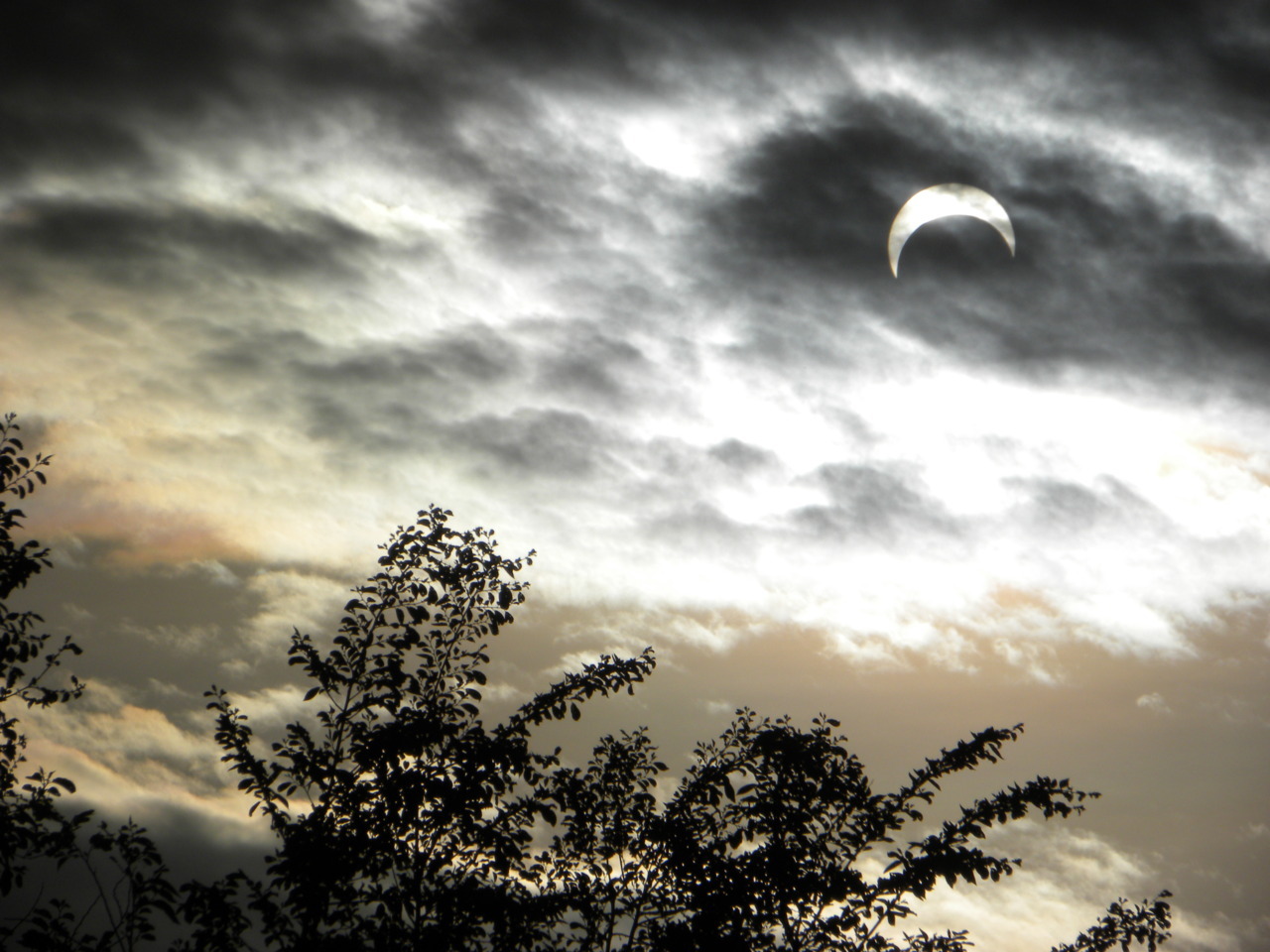
Photos: Yesterday's Eclipse

DiscoveryNews: Eclipse Over Idaho

Gardnerville, Nevada.  (Photo: Cathleen Allison / AP via The Guardian)

DiscoveryNews: Eclipse in Gilbert, AZ as seen through a Fox 10 News camera.


Friday, May 18, 2012

Rare Annular Eclipse

A rare "annular eclipse" of the Sun will occur in our area (northern California) in the late afternoon of May 20, 2012. I encourage you to see it, regardless of whether you can be within the narrow path where the "ring of fire" will be visible. (You will at least see a deep partial eclipse of the Sun, if you are in the western US.)


An annular solar eclipse occurs when the Sun, Moon, and Earth are lined up, but the Moon is farther than average from Earth, so it looks a bit too small to fully cover the Sun. Thus, if you are at one of the right places (see the below map), the Sun will form a ring, or annulus, around the Moon. It's a special form of a partial solar eclipse that's cool to see (though not nearly as dramatic and mind-blowing as a total solar eclipse). You can view a map showing the eclipse path in detail here.

Online, you can zoom in on it and find specific locations from which the eclipse will be visible. Click on the location to find times, etc. Note that "UT" is "Universal Time" (the time in Greenwich, UK), and right now it is 7 hours ahead of PDT. So, for example, I find that in northern CA, the middle of the eclipse will occur around 6:28 pm PDT on May 20 (1:28 am UT on May 21), and the annular phase will last about 4.5 minutes if you are near the "centerline." (Note: the non-annular partial phases will last much longer, a couple hours total: 5:20 pm to 7:34 pm, plus or minus a few minutes, depending on exactly where you are.)

The centerline (from which the Moon will appear perfectly centered on the Sun at mid-eclipse) is the orange curve, and the blue lines mark the northern and southern edges of the path of annularity; outside the blue lines, you'll see a partial solar eclipse but not a complete annulus or ring. So, try to go to a favorable location, within the brown swath. Choose your location wisely! You can find a summary graph that shows the percent cloudiness along the path here.

Oroville in CA (near Chico) has great odds, it seems: just 11% cloudiness. But it isn't super close to the centerline; Redding and Mt. Shasta are closer, but have somewhat worse odds. If you are between the two red lines, you'll see a complete "ring of fire." Outside that band, you'll see a partial eclipse, but not a full ring. You don't have to be right on the centerline, by the way -- just within the swath, if you want to see the "ring of fire," though it will last longer if you are closer to the centerline.

More info about weather patterns is given here at the following websites:
http://home.cc.umanitoba.ca/~jander/ase2012/ase12intro.htm
http://home.cc.umanitoba.ca/~jander/ase2012/climate.htm

Have fun viewing the annular eclipse, but be sure to view it safely! And if you can't get to the path of annularity (the brown swath in the map), at least view the regular partial eclipse from wherever you happen to be at the time (late afternoon on May 20), if it's visible.

Sunday, December 11, 2011

Lunar Eclipse

You may have noticed, with Saturday's total lunar eclipse, a dark patch that became visible around the moon. This is caused by the Earth's shadow. The shadow, which includes the atmosphere, suppresses the Rayleigh and Mie scattering components in the atmosphere and causes a local darkening. (The Rayleigh effect is the same effect that causes the sky to turn red at sunset.) While this is actually happening all the time, it is only so pronounced when seen against a low light background.