Showing posts with label education. Show all posts

Wednesday, March 27, 2013

Terry Pratchett: Facing Extinction


Pratchett alongside an endangered red ape
Bestselling author Sir Terry Pratchett, known in particular for his Discworld novels, returns to the jungles of Borneo in the last segment of this trilogy. Eighteen years ago, he encountered orangutans in the wild for the first time and this documentary follows his return to Borneo where he hopes to encounter them again and discover what the future holds for these amazing creatures. The experiences of his first trip caused him to become a trustee of the Orangutan Foundation, a UK charity devoted to protecting both the animals and their habitats.

In this segment, Pratchett and his assistant visit an Indonesian street market that is rumored to sell endangered animals and meet up with Dr. Birute Galdikas, the world expert on orangutans and president of Orangutan Foundation International. The most powerful piece of the documentary is the travel into the jungle to find the intelligent orangutans, in particular Kusasi, described as the “former king of the orangutans.”

The reality of the situation sets in when Pratchett asks a local conservation worker: “Would the people of Borneo care if all the orangutans were wiped out?”

“No,” she responds, “Ninety percent wouldn’t care a bit.”

This documentary is especially emotional for fans of Pratchett’s because in 2007 he was diagnosed with early-onset Alzheimer’s. Watching him struggle through the perils of the jungle is guaranteed to wrench anyone’s heart.

The hour-long show broadcasted on BBC Two at 21:00 GMT, but can also be found here.

Friday, March 15, 2013

Reddit AMA: Alex Filipenko


Yesterday, Alex Filipenko, a famous astronomer as well as an astrophysics professor at UC Berkeley, did an AMA on Reddit. For those who don't know, an AMA is an "Ask Me Anything" done Q&A style on the social media site. Most of the questions revolved around the future of space exploration and research. Below I have posted some of the more insightful questions with the corresponding responses. You can view the AMA yourself, here.

Q: Where do you think we will be regarding space travel/research in 50 years? 100 years?
A: Hard to say, that far in advance. I hope we will understand dark matter and dark energy. I hope definitive evidence for extraterrestrial life is found by that time. I'm almost certain we will have directly detected gravitational waves. Regarding space travel, maybe within that time, people will land on Mars for the first time.

Q:  How will we understand or detect dark matter/energy? Will this happen in the next 50 years?
A: Physicists are trying to directly detect dark matter in terrestrial labs. I think dark matter will be found this way in the next 20 years and if not, we need to go back to the drawing board! Dark energy will be much more difficult to directly detect, so I'm not sure it will happen in the next 50 years. Without direct detections, a more complete understanding of both dark matter and dark energy will come from from detailed observations of how they affect the universe. Other astrophysicists and I are busy collecting data that are setting ever more precise constraints on the physical nature of dark matter and dark energy.

Q: You mentioned education reform; what kind of reform do you think would help instill an actual love of knowledge in kids today? Do you think that our current system of just memorizing things and taking tests is sufficient? What do you think we can do instigate that change?
A:  Education reform is a very difficult issue. We have to excite kids about math and science at an early age. We might succeed in part by making these subjects more fun (check out http://www.piZone.org, for example). We have to show kids how math and science are relevant to their lives, and how beautiful they are. Of course, some facts must be taught, but the process of science and discovery should be emphasized more.

Q: What do you think of all the exoplanets being discovered?
A: It's totally fantastic! This is truly a "golden age" for research on exoplanets. In the past few years, the Kepler spacecraft has found a few thousand exoplanet candidates, more than 90% of which are probably genuine exoplanets. Studies of the "Doppler wobble" of the stars they orbit, and other observations, are gradually confirming more than more of them. Some are in, or near, the "Goldilocks zone" where liquid water might be found on the surface. Some are roughly the size of Earth. These will be excellent locations to search for life.

Q: What made you decide on astrophysics as a career?
A:  I've always been fascinated by science. From ages 10 through 17, my main interest was chemistry, but as a freshman in high school I was given a small telescope. With it, I "discovered" Saturn the third "star" at which I pointed the telescope! This really jazzed me, and astronomy became a growing interest. In my freshman year of college, at the University of California at Santa Barbara, I took an introductory astronomy course from Professor Stanton J. Peale, and it was truly wonderful. I realized that the physics of the very large is governed by the physics of the very small (atoms and subatomic particles), so by switching to astrophysics I could "have it all." So I changed majors with the intention of becoming an astrophysicist, and I've never regretted the choice.
One final factor in my decision: As a budding young chemist, I played with explosives and had a couple of pretty bad accidents. I realized that I don't have the self-discipline to stay away from dangerous chemicals, so I should switch fields as an act of self-preservation, if nothing else!

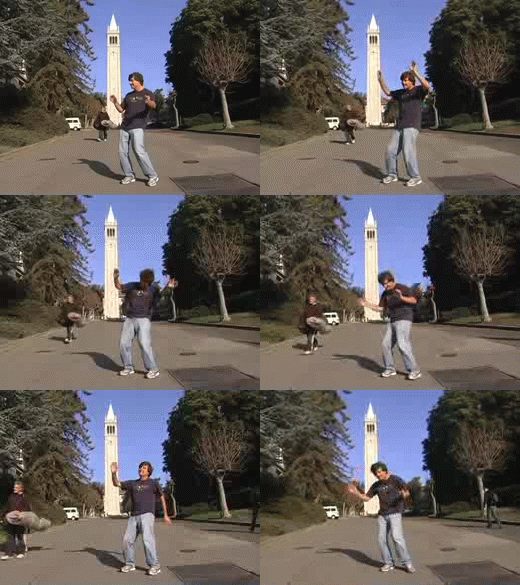
Go here to read the rest of his responses, some more serious and some more silly. (Fun aside: Someone also posted a GIF of Filipenko dancing on the Berkeley campus.)

Wednesday, October 24, 2012

Bay Area Science Festival


The Bay Area Science Festival is a week-long celebration of science that kicks off later this week. UC Berkeley and Science@Cal are involved in a number of exciting events, beginning with not one, but two star parties on Friday (one at the Lawrence Hall of Science for everyone, and a second teen-exclusive event at the YMCA Teen Center in downtown Berkeley).

You can also hike the Hayward Fault with UC Berkeley seismologists, explore what you eat at local farmers' markets, learn about the amazing things plants can do, enjoy the chemistry of brunch, investigate the intersection of art and science at a two-night exclusive gallery gala in downtown Berkeley, and join 25,000 others for the big finale at AT&T Park on November 3rd.

Many of these events are free. For a few of them, a small fee applies and / or registration is required.
Details of Science@Cal's participation in these events can be found on their website here.

The main festival webpage, featuring other events taking place across the Bay Area, is at Bay Area Science.

Also, save the date for the next Science@Cal lecture, November 17th, featuring Prof. Rosemary Gillespie, Director of the Essig Museum of Entomology, talking about evolution on remote islands.

Science Education Kickstarter


Wonderfest, the nonprofit San Francisco Bay Area Beacon of Science, has just begun a Kickstarter campaign to support a new, online, video series called "Radical Physics." Alex Filippenko, one of the world's most highly cited astronomers and a professor at UC Berkeley, will be part of the series.

You can take part by contributing as little as $1. And if you want a tangible reward, you can pledge $10 or more. All contributions (including big ones!) will be very welcome, and are tax deductible.

To appreciate this campaign -- and the educational need for Radical Physics -- please see the following web page. If you wish, watch the short-and-fun video and check out the various rewards of the Energy Radical Physics Video Series.

Wednesday, September 12, 2012

Pi Art in the Sky

If you look up into the sky today in the SF Bay Area, you will see skywriting planes creating an art installation called "Pi in the Sky."  What is this?  Why pi?

This artistic presentation of sky calligraphy will be the world's largest ephemeral art installation. Five synchronized planes will draw the first 1000 digits of the infinite sequence of pi (π, 3.14…), the ratio of a circle's circumference to its diameter.

Though created by an SF-based artist (ISHKY) as a community-building civic art experience, this event also provides an interesting educational opportunity, reminding us of the importance of math and science in our lives.

It is supported by piZone.org, a crowd-source resource that uses pi to educate and engage students and the public to become more interested in math and science with interactive games, educational videos, activities/demos, and pi art.  For more information, see the press release here.

We invite you to pi-ticipate!

Share the pi with people in the Bay Area and beyond.


Estimated Flight Times and Cities

San Jose  ~11:30
Oakland   ~12:00
San Francisco   ~12:10
Palo Alto       ~12:30
San Jose        ~12:40

Friday, July 27, 2012

Astronomy Picture of the Day

Two accomplished astronomers run Astronomy Picture of the Day and put up interesting and gorgeous astronomy pics every day. They have been at it since 1995, and haven't skipped a single day. The look of the website hasn't changed much -- basic HTML, but the one paragraph of text below the picture often gives an insight into our universe and modern astronomy. Their forums are pretty cool too, for those interested.

Wednesday, May 9, 2012

Do You Feel the Attraction?

Why are people so drawn to magnets? (Bad pun, I know.) Magnets truly are fascinating, and a mini-movie was filmed at the NASA Space Sciences Laboratory, UC Berkeley, in 2007 showing just the amazing research that goes on regarding magnetic forces. Everything shown in the movie takes place around those laboratories as the scientists describe their research and discoveries. These scientists develop and conduct experiments and instruments to study the magnetic fields above the sun and to create theoretical models.

The site describes the movie saying, "Magnetic Movie is the aquavit, something not precisely scientific but grants us an uncanny experience of geophysical and cosmological forces." Take a gander at the short movie, it's beautifully artistic and cleverly done.

Thursday, March 15, 2012

Happy (Belated) Pi Day!

Yesterday was "National Pi Day" -- March 14 (3.14). It has been declared by the U.S. House of Representatives as a way to introduce children and adults to the wonders of math and science (HR 224, in 2009). Pi is one of the most widely used mathematical constants in science and engineering, but only a relatively small fraction of the general public knows of its significance (perhaps beyond the circumference of a circle being pi times its diameter).


In honor of Pi day, I thought I'd introduce you to a website dedicated to your favorite mathematical concept: Pi! The wife of one of my favorite professors at Cal, Alex Filippenko, created a website designed an educational and entertaining website, piZone.org, in order to promote National Pi Day as a day to celebrate the fun facts, trivia, and uses of pi.

From an email I received from Alex:

The site has various videos, interactive games, and even pi-related t-shirts –- everything a person needs to celebrate pi. Moreover, you can enter to win an iPad (whichshe calls a "Pi-Pad") or t-shirts; click on the "Play" button, or "like" piZone on Facebook. (No purchase is necessary to win.)

The website is her social mission, and it was created as a crowd-source resource. Under the "pi it forward" program, $3.14 from every t-shirt sale goes to provide a pi-related t-shirt to a K-12 teacher.

I invite you to visit the website or Facebook (piZone) and help share the pi.
-Alex


Check out the site, it's pretty pi-tastic! And, because I can't resist, in honor of Pi day, my favorite Pi riddle:
Question: What do you get if you divide the circumference of a jack-o-lantern by its diameter?
Answer: Pumpkin Pi!

Monday, March 12, 2012

Introducing TED-Ed:

TED Talks is rolling out their new program: TED-Ed. This is set to be a series of TED Talks, under ten minutes in length, whose intention is to potentially rival Khan Academy.

I think the idea is fabulous, and the more well funded, educational services out there and accessible by students, the better. From the video description: TED-Ed's mission is to capture and amplify the voices of great educators around the world. We do this by pairing extraordinary educators with talented animators to produce a new library of curiosity-igniting videos.

In fact, they make it simple for you to nominate a teacher or animator. This can be done here.