Wednesday, January 30, 2013

Color in the Eye of the Beholder

When you look at a traffic light, what colors can you name? Most people will say that the lights are red, yellow, and green. However, Japanese people often will refer to the light as being blue in color, not green. This has its roots in the history of the Japanese language, as their word ao—until the modern period—covered both green and blue. Ao in Japanese comes from the dye plant, ai, which as a dyestuff covers the whole of the blue-green portion of the spectrum.  Some cultures have what might at first seem to be peculiarly chosen "basic" color names until you learn their associations with the culture's central food sources or dye plants, or precious commodities.

The color name that covers both blue and green in many native languages of the American Southwest is also the name for the stone, turquoise. You can be certain that, in cultures where a staple food is poisonous when green and edible when red, there are separate names for green and red. In our own history, we have a very similar example to the "blue" traffic lights of Japan: "orange" didn't enter English as a color name until the 16th century, after the fruit itself was first brought to England, quite late in the evolution of our color vocabulary, which is why we still refer to "red" hair.

Berlin & Kay—early theorists of the order of evolution of color names—had to, at some point, translate the names their subjects gave to colors into English in order to assign them a place in their evolutionary chart. Often they did this using bilingual subjects, which is of course problematic, since they would already think or operate in two different linguistic color spaces. When they used dictionaries, how had the dictionary writer decided on the English equivalent of the color name?
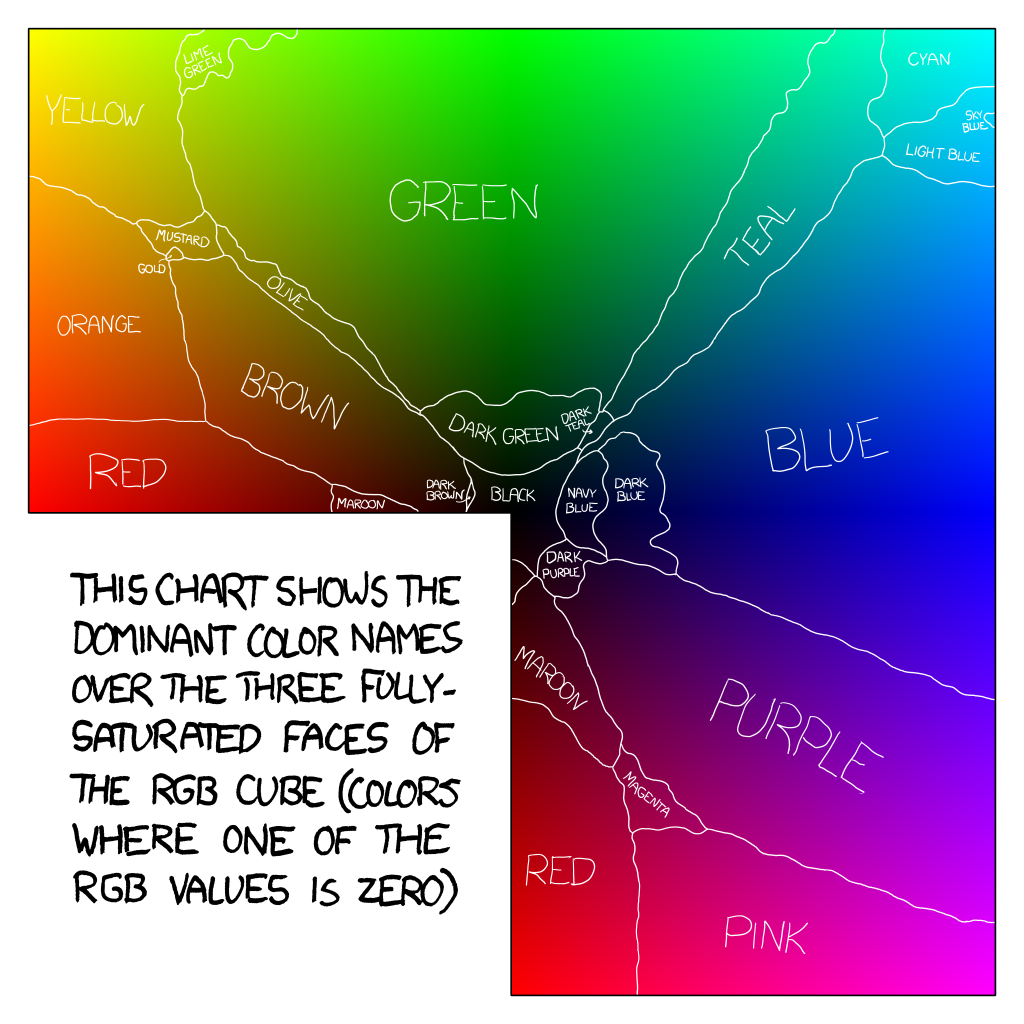


Finally, most male English speakers can come up with eleven independent color names, but female speakers are far more likely to come up with dozens of color names without straining. Girls are culturally conditioned to be familiar with this terminology from an early age.
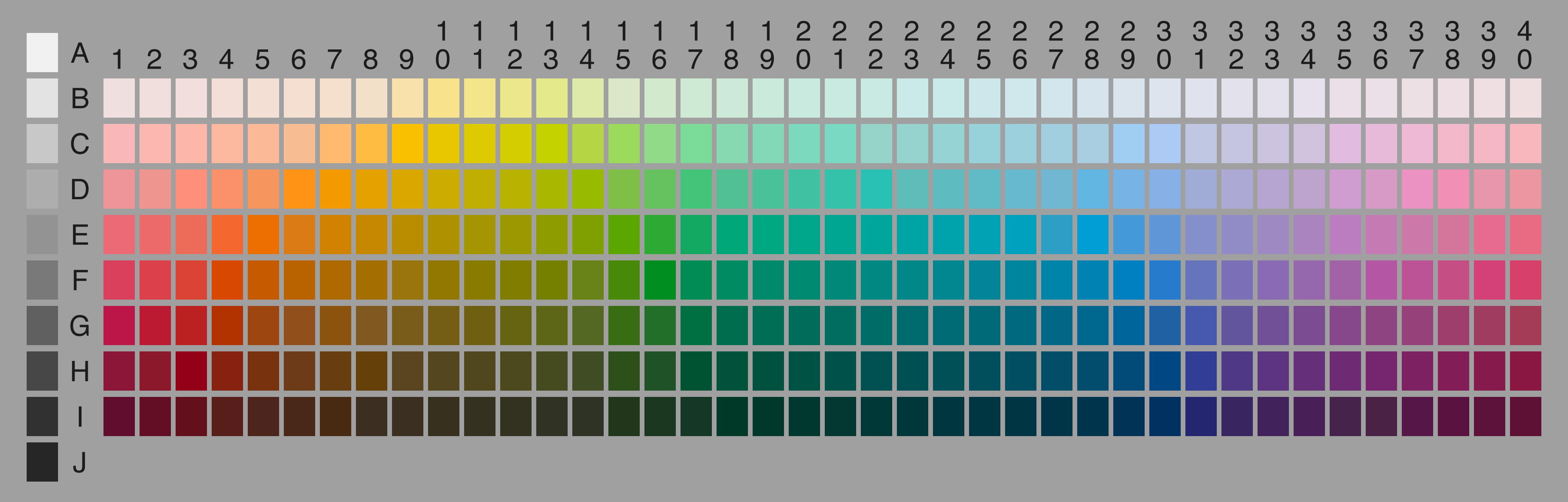
 If you want to participate in a color naming experiment, visit colornaming.net, as the folks over there are trying to determine an online color naming model.

Saturday, January 5, 2013

Density of the Universe

The density of the universe seems to be about 10-30 grams per cubic centimeter (source). With a proton having a mass of about 1.67 * 10-24 grams, we have about one proton per million cubic centimeters, i.e. one proton per cubic meter. Since electrons are much less massive than protons, this is also approximately equal to about one hydrogen atom per cubic meter.

So if the mass of the universe were spread evenly throughout space, how much could a container fit? A ten-liter container would thus hold about one-hundredth of a hydrogen atom. Not a lot!
Imagine all the mass of the universe was the size of marbles--how far apart would they be? Assuming all matter is divided up into pebbles, and assuming a pebble has a mass of about 4 grams, this means that we would need 4 * 1030 cubic centimeters (4 * 1015 cubic km) of volume for every pebble to get the right matter density for the universe. This is a lot; assuming equally spaced pebbles, this means that the average distance of one pebble to its closest neighbor is about 1.6 * 1010 cm, or 160,000 kilometers. To put this into perspective, if one pebble is the earth, and another the moon, there would only be one pebble sized distance between them.

Friday, December 14, 2012

Geminid Meteor Shower

If it's clear where you live, take a look at the Geminid meteor shower tonight, starting around 10 pm but especially after midnight. The peak was last night (Dec. 13/14), but tonight (Dec. 14/15) should be quite good as well. You can look anywhere in the sky. For more information, check out the EarthSky site.

Monday, November 12, 2012

Supersymmetry dealt a blow

The popular physics theory of supersymmetry was dealt a blow by the publishing of a crucial paper by CERN. Physicists who work at the Large Hadron Collider (LHC) look at specific particles, which are unstable. This just means that they split into smaller particles as they decay. Of course, there are many different kinds of smaller particles into which the larger particle can split. Some of the decays rarely happens.

According to the standard model, the decay in the question only happens in three out of 109 B-decays (A B-decay is a decay where a B-meson decays. A B-meson is a particle consisting of a anti-bottom quark and an up, down, strange, or charm quark). The fraction of all decays that lead to a particular final result is also called the branching ratio. So of all the possible decays that the B-meson can do, only 3 x 10⁻⁹ of the decays lead to the decay in the paper. Actually, they treat two different B-decays, but the branching ratio of both of them is in the order of magnitude ~10-9 - 10-10. According to Supersymmetry, the branching ratio of these decays is much higher.

What this all comes down to is if we have a billion of the large particles, only one of them splits into a certain combination of smaller particles. Thus, we say that the chance for that certain decay is one in one billion. The article is about one particular kind of decay.

Now, different theories have different chances for that particular decay of happenings. In the standard model, that is one in one billion. In super symmetry, it's maybe one in one million. That means it happens a thousand times more often.

Sometimes, scientists don't know whether a decay actually happens at all. But down at LHC, they've found the decay, so they know it happens. But they've only found it once out of maybe a billion other decays.

While this decay happens rarely, it happens many times in LHC. What's new with this publication is that they are now fairly certain that the amounts of decays they detect aren't some kind of freak accident or a problem with the test. The probability that background processes can produce the observed number of decay candidates is 5x10⁻⁴ and corresponds to a statistical significance of 3.5 sigma. That is that if they did the same experiment 5x10⁴ times, one of them would be wrong.

This all comes down to that the standard model predicts that one in one billion decays is that particular decay, but super symmetry predicts maybe a thousand in one billion decays is that particular decay. So, according to SUSY, this decay should have happened many more times than this single one they've found. This means that right now, the standard model seems correct and super symmetry has something wrong.


Monday, November 5, 2012

Hunting for the Higgs Boson

If you're in the East Bay tonight, you should check out the 2012 Segre Lecture at UC Berkeley. Peter Jenni, a CERN Scientist and former ATLAS Spokesperson, will present "Hunting for the Higgs Boson and more at the LHC." 

This annual lecture was conceived as a way for the Physics Department to honor and bring the work of an experimental physicist to the general public. Many renowned experimental physicists have been hosted. The observation of the Higgs Boson at the LHC was easily the biggest science story of the year, so this should be an excellent lecture. It will begin at 5PM in the Pauley Ballroom and is an lecture that any budding astronomer or science enthusiast won't want to miss! Click here to say you're going.

The lecture abstract is as follows:

For the past three years, experiments at the Large Hadron Collider (LHC) have begun exploring physics at the high energy frontier. A rich harvest of initial physics results has been obtained that allows us to test the Standard Model (SM) of elementary particles and to make searches Beyond the SM (BSM), at the highest energy level ever reached in a laboratory. Most exciting is the recent discovery of a new particle that may well be the long-awaited Higgs Boson. This discovery would also establish the postulated electro-weak symmetry breaking mechanism in the SM. Other far-reaching results can be reported for BSM physics searches like Supersymmetry (SUSY) and its implication for Dark Matter in the Universe, Extra Dimensions, and the production of new heavy particles. Besides these physics results, the history and technical challenges of the LHC project, its status, future physics prospects, as well as Cal and LBNL’s prominent role in them will also be covered briefly in this talk.

Wednesday, October 31, 2012

Adventures with America's Cup

 AC45 boats race during qualifying rounds this year 
(AP Photo/Eric Risberg; The Big Story)

In honor of all the America's Cup excitement here in the Bay Area, it's important to understand how these massive boats work.

One of the fundamentals of sailing is tacking into the wind. This translates into forward motion for a sailboat, when you might otherwise think that the boat would list or sail backwards. In fact, sailing ships have a keel that stops them from being just pushed sideways. Therefore, they can only go forwards or backwards.

When the ship faces into the wind at an angle instead of head on, it's possible to set the sails so that the force of the wind is pushing a little bit back and a lot sideways. So let's say the wind is coming from the north and the ship is facing northwest. A good sailor can set up the sail so that the force on the sails is a little bit south and a lot west.

Since the ship can only go forwards or backwards, the western force overcomes the southwards force, and the ship goes a lot west and a little north. If you then turn the ship northeast, you can go a lot east and a little north. Now you're farther north than you started, even though the wind is blowing from the north. If you turn your bow directly into the wind however, you will go backwards as your sails cannot catch the wind. This is an excellent way to cut your speed.

The sailors competing in America's Cup all possess incredibly precise intuitionbuilt from years of practiceregarding the degree they should be to the wind. It is thrilling to watch them compete and race towards their goal. Although the excitement is over for the year, they'll be back next year for an intense competition that promises to be exhilarating!

Wednesday, October 24, 2012

Bay Area Science Festival


The Bay Area Science Festival is a week-long celebration of science that kicks off later this week. UC Berkeley and Science@Cal are involved in a number of exciting events, beginning with not one, but two star parties on Friday (one at the Lawrence Hall of Science for everyone, and a second teen-exclusive event at the YMCA Teen Center in downtown Berkeley).

You can also hike the Hayward Fault with UC Berkeley seismologists, explore what you eat at local farmers' markets, learn about the amazing things plants can do, enjoy the chemistry of brunch, investigate the intersection of art and science at a two-night exclusive gallery gala in downtown Berkeley, and join 25,000 others for the big finale at AT&T Park on November 3rd.

Many of these events are free. For a few of them, a small fee applies and / or registration is required.
Details of Science@Cal's participation in these events can be found on their website here.

The main festival webpage, featuring other events taking place across the Bay Area, is at Bay Area Science.

Also, save the date for the next Science@Cal lecture, November 17th, featuring Prof. Rosemary Gillespie, Director of the Essig Museum of Entomology, talking about evolution on remote islands.